tattoos
Showing posts with label ENGINE. Show all posts

Monday, January 10, 2011

Subaru releases brand new boxer engine details

Subaru’s new boxer engine details have just been released and the main result is better fuel economy than the existing models whilst maintaining plenty of power and torque.

The new Subaru normally-aspirated (non-turbo) engine is the third generation developed by Fuji Heavy Industries, Subaru’s father company, and it’s the first brand new engine since 1989.
Subaru engines have always been robust, fairly powerful and very torquey especially when matched to high-geared ratios within Subaru’s all-wheel drive system. But the engines weak link has always been consumption and economy. It’s not that the engines are bad on fuel, they just consume a little more than the rivals.
Now though, Subaru and Fuji Heavy Industries have improved this area with indications noting a 10 percent increase in fuel economy. This was done through the use of lighter moving parts and an Active Valve Control system for the intake and exhaust.
The new 2.0-litre engine uses undersquare bore and stroke measurements too, meaning the pistons travel further than they are wide; 84mm bore and a 90mm stroke. This helps with torque and reduces the engine’s inclination to want to rev higher for more performance. Figures of 109kW and 196Nm are on offer.
Managing Director, Subaru Australia, Nick Senior said in a recent report,
“This is an exciting engineering development from FHI. They’re renowned for the durability of their engines and this new unit will take the sophistication to a whole new level that we’ll look forward to experiencing in some versions of our best-selling Forester next year.”
Subaru says the new engine will be available in both 2.0-litre and 2.5-litre capacities and will first go into the market with the Subaru Forester model year 2011, which will be launched early next year.

Friday, September 18, 2009

ENGINE BLUEPRINTING

Adalah sebuah proses mengatur semua toleransi pada sebuah mesin untuk mencapai hasil optimal. Yah… istilah gampangnya adalah membersihkan semua komponen mesin, mengatur ulang balance kruk as, mengatur deck clearance, men-setUp piston to head clearance, mengoptimalkan squish, skir ulang klep untuk mencegah kebocoran kompresi, memposisikan noken as supaya cam memiliki timing yang ciamik. Supaya motor bekerja optimal.

Apa yang didapat dari engine blue printing adalah Komponen mesin yang ditelanjangi total dan dibersihkan untuk diinspeksi ulang, transmisi primary dan secondary direposisi dengan shift drum, melakukan hone cylinder, pengecekan pada gap piston ring, seting squish piston, seting valve clearance, dialing camshaft, pemeriksaan jarak bebas piston dengan klep saat pemasangan noken as untuk klep besar. Yeah… this is what called by super set-up.

Menata crankshaft dan gearbox

Menata crankshaft dan gearbox

Mengatur Piston Squish

Mengatur Piston Squish

SET UP KAMPAS KOPLING 6 Sab

SET UP KAMPAS KOPLING 6 Sab

Installing The Cylinder Block

Installing The Cylinder Block

Crankcase modification for boreUp purpose

Crankcase modification for boreUp purpose

Deck Clearance Height setUp

Deck Clearance Height setUp

Kepresisian dalam pengaturan komponen mesin sangat mempengaruhi performa, itulah mengapa kita berusaha untuk sangat hati-hati dalam pemasangan camshaft agar dapat mebuka-menutup dengan teratur sesuai derajat timing tertentu. Meratakan permukaan cylinder head untuk kedudukan head gasket yang baru, untuk mencegah kebocoran kompresi.

Dialing Top Dead Center and Camshaft Timing

Dialing Top Dead Center and Camshaft Timing

Checking Overlaping Valve Clearance

Checking Overlaping Valve Clearance

Meratakan Permukaan Cylinder Head

Meratakan Permukaan Cylinder Head

Tujuan akhir dari blueprinting adalah menciptakan keharmonisan gerak seluruh komponen agar tercipta kesetimbangan dan meningkatkan efisiensi mekanis di dalam mesin. Blueprinting adalah awal dari tujuan lain yang lebih besar, yaitu kemudahan penyesuaian set up saat mesin hidup. Agar nantinya mesin dapat menelurkan performa yang mangstab saat di ajak jalan pelan maupun ketika di gas pooolll…!!! Hehehee…

Tuesday, September 8, 2009

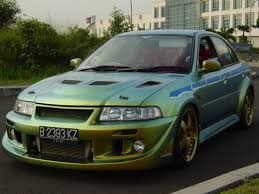
Mitsubishi Lancer 2002 Evo V Engine

Mitsubishi Lancer 2002 Evo V EngineEngine:
1) Mitsubishi EVO V, 4G63T, turbocharged ( bisa ampe 1,6 bar boost )
2) intercooler Ralli art
3) Radiator Calsonic
4) strut bar Cusco Limited Edition
5) Greddy oil catch tank
6) Apexi ground wire
7) Racing suction kit HKS
8) piping filter HKS
9) air filter HKS
10) Cusco sway bar
12) turbo timer
13) apexi boost controller
14) piggy back dastek
15) HKS dragger II with misfire system
16) full catback titanium piping from knalpot to the downpipe, 3

Exterior :
1) chameleon paint
2) 2 fast 2 furious sticker scheme
3) egoist front bumper
4) buddy club rear bumper
5) EVO VI sideskirt
6) EVO VI engine hood
7) C-west carbon wing
8) Xenon headlight

Saturday, February 21, 2009

Tuning a Rc Nitro Engine for Optimal Power


When I began the first time to pack the supplied cars with gas of RC, I was accustomed to fighting to enter the engine the air, whereas I could obtain the engine to start on a tenth of dollar and it functioned very well for almost a whole fuel tank, it always seemed to overheat close to the race end. After many hours outside on the way I can now finally say that I the 'VE is descended, the agreement for me is now an operation 5 minute before I remove my car of RC, and once it 's composed to me inside must only adjust one needle a fraction of a turn to again obtain it with him 'with optimal arrangements of S.

I suppose that your include/understand the foundations of an engine nitro of RC and how that functions, if not see my other articles please that you can find on my Web site, see the box of resource for details.

The screw with vacuum
I always start with the screw with vacuum, I adjust it so that the car idles high when I 'm initially composing in the engine. Once I obtain the engine until the temperature and with a tube which can continue it to slowly run me without lose speed downwards adjust the idle on the point where him 's approximately to fix, then I turn it behind approximately turn of 1/4 to 1/2 according to the temperature. If your stalls of car often it can be interesting to increase the idle to prevent this, him 's only one difficulty provisional while you sort the other exit of agreement, but helps him downwards of the levels of destruction of subsistence.

Switches at fallback speed.
One of the great discussions is of which needle to be adjusted initially, if your carburettor has only one adjustment screw of needle then him 's not a problem, but so as the majority of the engines of gleam you have two you have need to decide what to grant initially. I always start with the needle at fallback speed, this is because when you adjust the needle at fallback speed you change the needle at high speed. Once the needle at fallback speed is made up in you shouldn 't must still adjust it. You slightly ensure subsistence it rich side, when you conveys that RC idles the combustion chamber should start to fill of the fuel, this helps the fresh subsistence it. After one moment the engine will fix, by measuring this you can say if it is richer or thinner. A good time is approximately 30 - 60 seconds before it fixes. The car of RC should withdraw quickly beginning upright and would not owe embourber or to flame outside when you apply the full power control.

Switches at high speed.
Once you have your needle at fallback speed of adjustment made up in it 'time of S to start to obtain the power out of the engine of RC. This is done with the needle at high speed, which adjusts the air on the mixture of fuel of the engine while it as high T/MN (approximately 40% and rise). Keep an eye on the trail of smoke because it is your first index about the air. You want to have smoked much to leave the engine with all the T/MN, so at a certain point there is little or not smoke whereas you are
 

blogger templates | Blogger