


|
|
|---|


Showing posts with label Mini Cooper. Show all posts
Showing posts with label Mini Cooper. Show all posts
Tuesday, November 1, 2011

Friday, October 28, 2011
MINI Cooper Clubman presenteia clientes

Sempre apresentando propostas inovadoras, a marca MINI se prepara para mais uma ação exclusiva. Para lançar o MINI Cooper Clubman, versão aspirada de 120 HP, a marca uniu o charme do carro e o incrível design da MINI Folding bike.
Nesta oportunidade única, os 35 primeiros compradores do modelo irão ganhar de presente a inovadora bicicleta dobrável MINI: com 11kg, 8 marchas, rodas de aro 20”, quadro de alumínio e selim em gel, a MINI Folding bike tem duas características marcantes: estilo e inovação. Portanto, nada melhor do que unir essas qualidades à um charmoso modelo da família MINI, disponível em breve na versão Cooper.

Conhecido por “the other MINI”, o MINI Cooper Clubman chega ao Brasil no mês de novembro por R$98.950,00, e com uma taxa de financiamento especial de 0,98%, oferecida pela MINI Serviços
Wednesday, October 26, 2011
2011 MINI Cooper

The Mini lineup will enter the 2011 model year with an array of visual and equipment upgrades for the Cooper, Cooper convertible, and Clubman. The visual changes include a redesigned front bumper that helps the Mini meet new pedestrian-safety regulations in Europe. The lower grille and new fog-light surrounds have more pronounced, contoured borders. Base (non-S) models feature a new horizontal bar in the lower air inlet, while S models sport prominent (and functional) brake ducts that can be trimmed in chrome. There are five new wheel designs in 15-, 16-, and 17-inch sizes.
The exterior lighting has been revised with new trim rings for the side-marker lights, while black headlight surrounds, like those on the recent Camden anniversary edition, are now optional on all but John Cooper Works models. The brake lights now use LEDs, and the optional xenon headlights now swivel in turns. Reverse lights migrate to the lower bumper.
Updates to the interior will help appease those, like us, who found the Mini’s ergonomics less than friendly. The audio controls have been consolidated under the large center speedometer, and all secondary controls are now finished in matte black rather than silver, as are the steering-wheel-mounted audio and cruise controls.

Of all the ways to describe the Mini Cooper's interior, we doubt anyone would call it boring. The massive center-mounted speedometer is a nod to the original Mini, but in terms of practicality, it comes off as a bit gimmicky. One of our main gripes of previous Minis was the oddly placed stereo control knobs. Fortunately, that has been rectified for 2011 with a slightly more conventional layout.
Despite the Mini Cooper's small size, the front seats are surprisingly spacious. There is no shortage of headroom or legroom and the cabin feels extraordinarily airy. The rear seats, by comparison, are much less accommodating, with a notable lack of legroom. Trunk space is also restrictive, at a very meager 5.7 cubic feet, but folding the rear seats flat increases cargo capacity to a very usable 24 cubes.
The convertible features a tailgate-style trunk opening with an upper package tray that can be raised to allow larger items to fit in the tiny 6-cubic-foot trunk. Unlike most convertibles, the Mini's rear seats can be folded flat to accommodate larger items, but the rollover hoops and soft-top mechanism prevent the loading of bulkier objects. Rear visibility for the convertible is poor with the top down and even worse with the top up.
New optional extras include ambient lighting that can be set to any of 756 colors, and auto-dimming side-view mirrors. A cargo cover for Clubman models is now standard. New audio and navigation systems are available, with the latter using a 6.5-inch LCD screen in the Mini’s central speedometer. With Mini Connected software, iPhone and iPod users will be able to watch videos on the display while the car is parked, or see album cover art while playing music. The screen also will be able to display contact information from a compatible cell phone connected via Bluetooth.
The high-performance John Cooper Works trim gains an extra accent color, Chili Red, for the mirrors and roof. The color is also splashed on interior trim panels and stitching for the steering wheel, shifter, and parking-brake handle. JCW cars also score anthracite-gray gauge faces.

A more functional improvement is new anti-torque steer programming that keeps the wheels pointed forward under hard acceleration. The car does pull to the side far less than in the past, unfortunately, however, MINI has done nothing new to combat that spinning inside tire.
For several years now no mechanical limited slip has been offered on the MINI lineup and the Electronic Differential Lock Control (EDLC) system, essentially an electronic LSD, is engaged only when the DTC is shut completely off. MINI engineers insist it works as well as the real deal, but it certainly doesn’t feel that way and as it stands you’ll get plenty of wheel spin or DSC interference in low gears, when you input lots of steering and throttle. Besides, it would be nice to have the properties of a limited slip without having to turn off all the safety gear. Just because you’re in the mood for a spirited drive it doesn’t mean you’re at the track. Thankfully it’s by no means as unmanageable as the MazdaSpeed3, but it’s hardly ideal.
Even with the added power for 2011, MINI managed to eek out a little extra fuel economy – always a plus. The 6-speed manual now gets 27/36-mpg compared to 26/34-mpg, while automatics see a similar jump rising to 26/34-mpg from 24/32-mpg.

The 2011 Mini Cooper comes with a 1.6-liter four-cylinder engine good for 121 hp and 114 pound-feet of torque. A six-speed manual with hill-start assist is standard and a six-speed automatic is optional. Mini estimates a manual-equipped hatchback will go from zero to 60 mph in 8.4 seconds (9.7 seconds with the automatic). EPA-estimated fuel economy is 29 mpg city/37 mpg highway and 32 mpg combined with the manual (27/35/31 convertible) and 28/36/31 with the automatic.
The Cooper S has a turbocharged version of the same engine good for 181 hp and 177 lb-ft of torque (192 lb-ft at full throttle thanks to an overboost function). Mini estimates 0-60 mph acceleration in 6.6 seconds for the manual and 6.8 seconds for the automatic. EPA estimated fuel economy is 27/36/30 with the manual and 26/34/29 with the auto.
The John Cooper Works cranks up the turbo boost to produce 208 hp and 192 lb-ft of torque. A six-speed manual is the only available transmission. Mini estimates a 0-60 time of 6.2 seconds for the hatchback and 6.6 for the convertible. Fuel economy is 25/33/28.

All 2011 Mini Coopers come standard with antilock disc brakes, stability control and front-seat side airbags. Side curtain airbags are standard on the hatchback, while the convertible features pop-up rollover bars and larger front side airbags that extend to head height. Traction control is optional. In Edmunds braking, various Mini Cooper S models with 17-inch wheels stopped from 60 mph between 112 and 115 feet -- excellent results.
The Cooper has not been rated using the government's new, more strenuous 2011 crash testing procedure. Its 2010 rating (which isn't comparable to the new methodology) was four stars out of five for frontal and side impacts for both driver and passengers. The Insurance Institute for Highway Safety gave the hatchback its best rating of "Good" in the frontal-offset test, and its second-best score of "Average" in the side-impact and roof-crush tests.
reference:www.edmunds.com,www.autoguide.com,/www.caranddriver.com

2011 MINI Cooper Countryman

It feels like we've been waiting a decade for the arrival of the 2011 Mini Cooper Countryman, the crossover version of the Mini.
But not even two years have passed since the unveiling of the Mini Crossover Concept at the 2008 Paris Auto Show. We've followed test mules to the Arctic, to the Nürburgring and to Death Valley. Earlier this month, the Beachcomber concept in Detroit gave us a clearer look at the final styling.
Next stop is the 2010 Geneva Auto Show in March, where the production Countryman makes its official debut. And come January 2011, the 2011 Mini Cooper Countryman and the 2011 Mini Cooper S Countryman will land in the United States.

The first thing we noticed about the 2011 Countryman was that the tall people didn't immediately start making snide comments. The Countryman comes with 4-seat and 5-seat options, with either one offering plenty of back seat head and leg room. Trunk space was decent, definitely superior to the original Mini Cooper, and driver head room was drastically improved. Dash styling appeared very similar to the original Mini Cooper, with oversized dials and switches in whatever color you like. With smartphone integration, optional GPS navigation and plenty of room for cup holders, the 2011 Countryman's interior began to feel downright luxurious.
Those extra inches are going to good use, as the 2011 Mini Cooper Countryman's standard rear bucket seats have a 5.1-inch range of fore/aft adjustment. You don't have to be content with a four-seat Mini this time around, though. Order the three-place bench seat at no extra cost and your Mini Countryman will seat five. The bench will adjust fore/aft (albeit in 60/40 sections), and like the bucket seats, its seatback cushions recline.
When everyone's fully reclined, the cargo bay offers 12.2 cubic feet of capacity. Or you can make your passengers sit bolt upright and you'll have 15.4 cubes. Either way, a stroller will fit, says Mini, reminding us that the Countryman is aimed at those of us who have crossed over into the world of diapers and affectionate purple dinosaurs.
Drop the rear seats into the floor and you're met with 41 cubic feet in the Cooper Countryman, which is a significant jump over the 32.8 cubic feet in the Clubman. There's space enough for two 26-inch mountain bikes provided you remove the front wheels, according to Mini.

EXTERIOR
Mega Mini. Maxi Mini. Un-mini Mini. Yes, we're already hard at work inventing cute names for the 2011 Mini Countryman, the biggest Mini of them all.
Mini has yet to release full Specifications for the Countryman, but at 161.3 inches from its upright, pedestrian-compliant nose to its pancake-flat rump, the Mini crossover is 5.5 inches longer than the Mini Clubman and 15.7 inches longer than the wee Cooper.
More front and rear overhang is inevitable on a Mini transformed into a utility vehicle, but the wheelbase has also been stretched to 102.2 inches — almost 2 inches longer than the Clubman's and a solid 5 inches over the standard Mini Cooper hatch.

Pumping under the hood of this not so “Mini” 2011 Mini Cooper Countryman is a 1.6 ltr inline-4 engine, churning maximum power of 121 hp and 118 lbs-ft of maximum torque. The standard driveterain for this engine is front-wheel drive only, and the engine here is mated with a 6-speed manual transmission, which is standard transmission and optional transmission here is 6-speed automatic.
As far as performance is concerned, the 2011 Mini Cooper Countryman having manual transmission is estimated to sprint from 0 to 60 mph in 9.8 sec; while the same timings for the automatic transmission mated Mini is 10.9 seconds. Considering the fact that it’s foraying into compact SUV segment, we will say that it’s quite a compact SUV.
The 2011 Mini Cooper Countryman S on the other hand is powered by a turbocharged variant of the same 1.6 ltr engine, generating maximum power of 181 hp and 177 pounds-feet of maximum torque. The standard drive terrain here is all-wheel drive. The transmission choices for the S are the same, and even in terms of performance the car delivers almost similar performance.

The standard safety equipments for 2011 Mini Cooper Countryman S includes stability control, antilock disc brakes, side curtain airbags and front-seat side airbags. The Cooper Countryman S gets traction control additionally as standard equipment, while for the base 2011 Mini Countryman it’s optional. There also is option of getting rear parking sensors.
reference:www.automotivecraze.com,www.insideline.com,www.automobile.com

Thursday, August 25, 2011
Mini Challenge: etapa de Salvador define pilotos que brigarão pelo título da temporada 2011

Nos dias 3 e 4 de setembro os charmosos Mini Cooper vão desembarcar em Salvador para o primeiro momento de definição do campeonato. Assim como na Copa Caixa Stock Car, a sétima etapa do Mini Challenge, a categoria mais charmosa do Brasil, vai determinar quem são aqueles que terão chances de brigar pelo título na última etapa da temporada 2011.
A penúltima prova do ano promete grandes emoções no circuito urbano Ayrton Senna, montado nas ruas do CAB - Centro Administrativo da Bahia. A reta final do campeonato deve seguir com pegas e disputas acirradas, mantendo o bom nível técnico demonstrado nas seis etapas já realizadas. Nos dias 15 e 16 de outubro, no Distrito Federal, conheceremos o campeão do Mini Challenge.
O atual campeão Patrick Gonçalves segue firme em busca do bicampeonato, com 180 pontos, seguido por Raphael Abbate (168), comprovando a importância da regularidade no campeonato. O paulista ainda não venceu no ano, mas tem um ritmo constante, tendo pontuado nas 12 baterias. Por outro lado, o baiano correrá em casa, onde venceu as duas corridas de 2010, e contará de novo com o caloroso apoio da torcida soteropolitana.
Outro que também promete pisar fundo e dar trabalho aos adversários é o gaúcho Vitor Genz, terceiro colocado (150 pontos). Embalado pela vitória em Interlagos, no começo do mês, o representante do Rio Grande do Sul só pensa em vencer nas ruas de Salvador para poder se aproximar dos líderes e brigar pelo título na última em Brasília. Vale lembrar que todos os pilotos devem descartar os dois piores resultados.
A temporada 2011 do Mini Challenge tem se mostrado muito competitiva e equilibrada, com a presença de grandes pilotos: como o atual campeão Patrick Gonçalves, que inclusive tem representado o Brasil na disputa argentina do Mini Challenge, além dos experientes Rolf Gemperli, Rodrigo Hanashiro, Rogério Nassrralla, entre outros. Sem contar os estreantes que também estão brilhando na competição.
Os carros modelo MINI John Cooper Works CHALLENGE são importados da Inglaterra e utilizam motor de 221 hp, com quatro cilindros em linha, com turbocompressor, injeção direta de gasolina.
FICHA TÉCNICA - CARROS DO MINI CHALLENGE:
Motor: com quatro cilindros em linha
Freios: freios a disco ventilados
Pneus: Dunlop
Combustível: gasolina
Peso do carro incluindo o piloto: 1.180 kg
O Mini Challenge utiliza os carros MINI John Cooper Works CHALLENGE modelo 2010.
Tuesday, August 2, 2011
MINI Challenge Cup : A " hora da verdade " na briga pelo título

Pilotos e equipes da categoria mais charmosa do Brasil estarão mais uma vez no circuito de Interlagos, para a disputa da 6ª etapa do campeonato, que acontece nesse final de semana, 6 e 7 de agosto.
Como é característica nas corridas do MINI Challenge Cup, bons pegas e muitas emoções serão fatores garantidos. A prova é considerada como a “hora da verdade” para muitos pilotos que ainda pretendem continuar na briga pelo título de campeão, pois além dessa, somente mais duas etapas – Salvador e Brasília – restarão para completar a temporada 2011.
O piloto Patrick Gonçalves segue na liderança com 140 pontos, apenas dois de vantagem sobre Rafael Abbate, o vice-líder com 138 pontos.
Além do líder e vice-líder, outros pilotos seguem confiantes e esperam por bons resultados para tentar somar mais pontos na tabela de classificação. É o caso de Rogério Nassralla, terceiro colocado no campeonato com 131 pontos. Para o piloto, somente o pódio interessa. “Espero chegar entre os três primeiros para continuar na briga pelo campeonato, mas São Paulo é uma pista onde a maioria dos pilotos treina e onde todos já correram muito, o que não é o meu caso. Corri em Interlagos somente duas vezes e isso vai exigir um resultado mais preciso.”
Os catarinenses Davi Dal Pizzol e Felipe Tozzo vão para Interlagos empolgados com os bons resultados obtidos até agora e acreditam em melhorar ainda mais. “Estamos no caminho certo. Temos apresentado bom desempenho em nosso primeiro ano e estamos entre os primeiros. Isso é muito bom para nós e para os patrocinadores. Ficamos felizes em representar bem o estado de Santa Catarina”, diz Dal Pizzol.
Já para Tozzo, Interlagos é um local especial. “Gosto muito do circuito onde conquistei minha primeira vitória este ano, a primeira bateria da 2ª etapa. Agora, o regulamento permitirá a utilização de mais pneus novos. Com isso teremos ótimas condições para vencer.” A dupla é a quinta colocada na classificação com 117 pontos.
Já para o piloto Rodrigo Hanashiro os resultados da última etapa foram importantes para que ainda continue em pensar no título. “Depois da prova do Rio, mostrei que ainda estou vivo no campeonato e pontuar lá foi essencial. Estou animado. Os pneus novos poderão me ajudar a buscar um bom resultado. Vamos que vamos!” Hanashiro soma 100 pontos na classificação e divide a 7ª posição com os pilotos Matheus Castro, Bruno Henriques e José Mario de Castilho.
As duas corridas da 6ª etapa do MINI Challenge Cup, serão transmitidas ao vivo pelo canal por assinatura BAND Sports. No sábado, a primeira corrida acontece às 14h50. Já no domingo às 08h00, acontece a largada da segunda corrida. O resumo completo das duas disputas você acompanha no domingo, no programa BAND Esporte Clube.
VISAR PLANEJAMENTO - Ass. Imprensa BMW Group Brasil
Monday, August 1, 2011
Minimalismo de luxo vende bem

Pedro Kutney, AB
www.automotivebusiness.com.br
www.automotivebusiness.com.br
O minimalismo de luxo do MINI acertou em cheio o gosto de consumidores brasileiros – claro, só aqueles que podem pagar de R$ 69.950 a R$ 149.950 pelo carrinho de dimensões diminutas, aparência inversamente chamativa e preço espaçoso. O desempenho comercial do MINI no Brasil surpreende. “As vendas estão acima de todas as expectativas iniciais”, conta Martin Fritsches, diretor de vendas e marketing da marca no Brasil. “Em 18 meses de mercado fizemos aqui o que esperávamos fazer em quatro anos”, completa.
A tradicional marca britânica, controlada pela alemã BMW desde o fim da década de 90, chegou ao Brasil só na metade de 2009. A crise financeira mundial fez sobrar algumas unidades e isso venceu a resistência em mandar o carrinho para cá, pois ninguém na BMW acreditava que um subcompacto de luxo pudesse dar certo aqui. A crença era de que quem tivesse dinheiro optaria por um modelo maior. Ledo engano. No primeiro ano inteiro de vendas do MINI por aqui, em 2010, foram emplacadas 1.720 unidades, número que, pelo ritmo atual, deverá crescer impressionantes 45% este ano, para 2,5 mil.
“Nossa expectativa é de continuar crescendo acima do ritmo do mercado”, avisa Fritsches. Das três versões do MINI trazidas em 2009, as 15 concessionárias hoje já oferecem 11 das 16 disponíveis (incluindo até uma 4x4), com opções de motores de 98, 122, 184 e 211 cavalos. Neste mês chegou a mais barata delas, o MINI One com câmbio manual, por quase R$ 70 mil. Até o começo de 2012 deve chegar também o One automático. Por enquanto o mais vendido continua a ser o MINI Cooper S automático.
Monday, July 18, 2011
Novo modelo da família MINI chega ao Brasil

A família MINI ganha um novo integrante no Brasil, o MINI Cooper S John Works Cabrio.O MINI John Cooper Works Cabrio é o terceiro modelo da linha esportiva. O carro é equipado com o motor Twin-Scroll-Turbo, de quatro cilindros de 211 HP, o mesmo motor utilizado nos carros de competição da MINI CHALLENGE CUP. Com este motor, o MINI John Cooper Works Cabrio é capaz de acelerar de 0 a 100 km/h em apenas 6,9 segundos, alcançando uma velocidade máxima de 235 km/h. Além do motor com injeção direta de gasolina, seus freios, rodas e outros numerosos componentes específicos, assim como diversos detalhes inspirados no automobilismo, proporcionam um desempenho extraordinário e único neste segmento. O máximo nível de segurança se deve, entre outros elementos, à barra anti-capotagem que é ativada automaticamente em caso de necessidade e ao sistema de controle dinâmico da estabilidade (DSC), que inclui o sistema de controle dinâmico da tração (DTC). Estes valores são a expressão de um prazer de dirigir sem igual no segmento, somados ao prazer de dirigir um carro conversível e econômico.
O modelo estará disponível para comercialização a partir do final de julho nas concessionárias MINI, ao preço de R$149.950,00.
Thursday, June 23, 2011
2011 Mini Cooper Sport Black preview and specification
2011 Mini Cooper Sport Black preview and specification 


Thursday, June 16, 2011
2008 mini cooper s john cooper works tuning kit preview and specification
2008 mini cooper s john cooper works tuning kit preview and specification 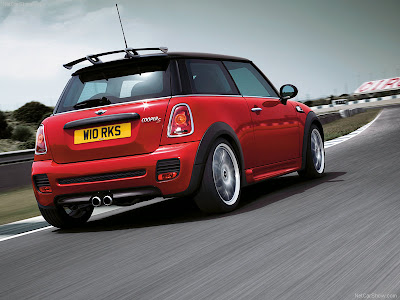


Tuesday, June 14, 2011
2011 mini cooper s countryman car specification and features expetise
2011 mini cooper s countryman car specification and features expetise 


Friday, August 7, 2009


Friday, July 3, 2009
2009 MINI One D

The MINI model family is set to welcome another new arrival. A new entry-level diesel model will be launched in September 2009 and promises to deliver exceptionally economical driving fun. The MINI One D showcases the qualities of its state-of-the-art diesel engine as part of an attractive entry-level package. The drive system is based on the 1.6-litre diesel engine from the MINI Cooper D. Featuring a turbocharger and common rail direct injection, the new version of this four-cylinder unit develops peak output of 66 kW/90 hp and maximum torque of 215 Nm. Like the petrol-driven MINI One, the new MINI One D provides a particularly economical entry point into the world of the MINI brand, which is defined by driving fun and premium quality.
Instantaneous pulling power and impressively low fuel consumption are also keynote attributes of the MINI One D. Its 1.6-litre four-cylinder engine features common rail direct injection technology and a turbocharger with variable turbine geometry, which ensures optimum power development through the entire engine speed range. Boasting an exceptionally lightweight aluminium construction, this four-cylinder diesel powerplant develops 66 kW/90 hp at 4,000 rpm and sources its peak torque of 215 Nm from as low down as 1, 750 rpm. The MINI One D completes the sprint from 0 to 100 km/h in 11.5 seconds and hits a top speed of 182 km/h.
The new MINI One D is also fitted as standard with a diesel particulate filter and numerous efficiency-enhancing measures, which make an effective contribution to reducing fuel consumption and emissions. These include Brake Energy Regeneration – which concentrates power generation for the on-board power supply on periods when the car is braking and coasting – and the Auto Start Stop Function, which switches off the engine when the car stops at traffic lights or a junction. The MINI One D also comes with a Shift Point Display, which advises the driver of a good time to change gear to ensure efficient driving. The average fuel consumption of the MINI One D in the EU test cycle is 3.9 litres per 100 kilometres, while CO2 emissions stand at 104 grams per kilometre.
A precise six-speed manual gearbox makes every burst of acceleration in the new diesel model a genuine pleasure. As with all the brand’s models, the drive is sent to the front wheels of the MINI One D and – like its siblings – a central feature of its character is the go-kart feeling typical of the brand. This delightfully agile handling is underpinned by a combination of a McPherson spring-strut front axle construction, multi-link rear suspension and Electrical Power Steering (EPS). Speed-sensitive steering assistance guarantees both low steering forces when parking and precise responses at motorway speeds. In addition, EPS also enhances the efficiency of the car; the electric motor is only active, and therefore only uses energy, when steering assistance is required or desired by the driver. Among the safety features on board the MINI One D are front airbags and side head/thorax airbags, and all four seats are fitted with three-point inertia-reel seat belts. All restraint systems are controlled by a central safety electronics system complete with sensors, and are applied as required by the type and intensity of the collision.
The standard equipment of the new entry-level diesel MINI matches that of the MINI One and its appearance likewise shows parallels with its petrol-driven equivalent. The MINI One D also has its roof in body colour, while its model-specific take on the typically MINI hexagonal radiator grille stands out from the other model variants with a chrome surround and black cross louvres. Like the MINI One, the MINI One D also has black mirror caps and a black boot lid handle, and the chromed tailpipe is the same as that on the exhaust system of the MINI Cooper D.
The market launch of the new entry-level diesel variant adds further to the variety of the MINI model range. In addition to the two diesel models – the MINI One D and MINI Cooper D – customers can also choose from the petrol-driven MINI One, MINI Cooper and MINI Cooper S, and the particularly sports-oriented MINI John Cooper Works. All models are built according to the strict quality standards of the BMW Group at the MINI plant in Oxford. The MINI One D is also available with the extensive selection of optional extras and accessories which allow every MINI to become a personalised one-off example of its kind.


Sunday, June 28, 2009


Subscribe to:
Posts (Atom)


